
JustBet Games: Slots, Tables, Poker and Originals
 Available in AU
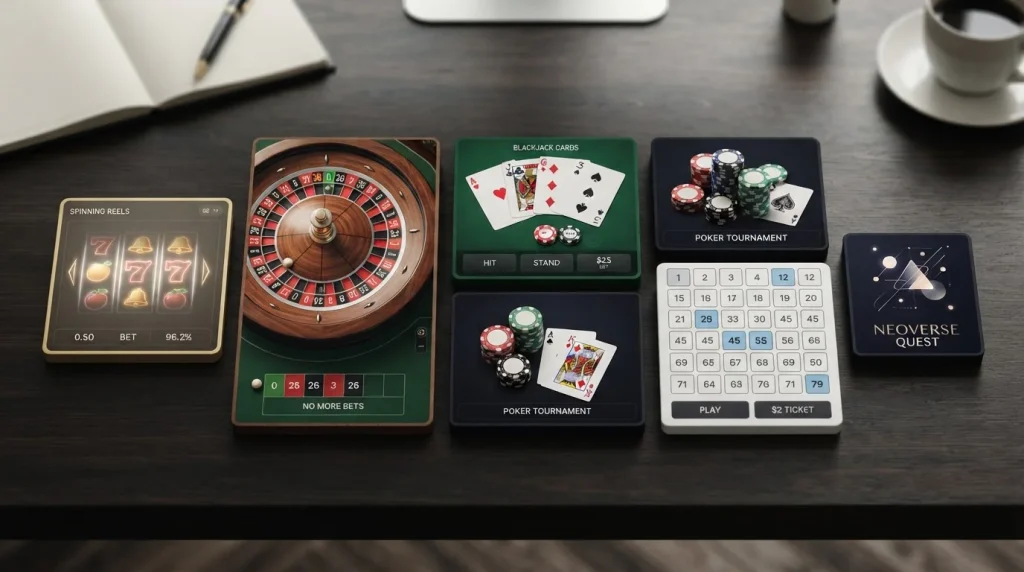
JustBet combines conventional casino categories with creator-published games. Its catalogue names slots, blackjack, roulette, PvP poker and originals, alongside other formats listed in an independent casino profile. Understanding the differences between their game rules, random outcomes and crypto settlement is more useful than treating the catalogue as a single type of game.
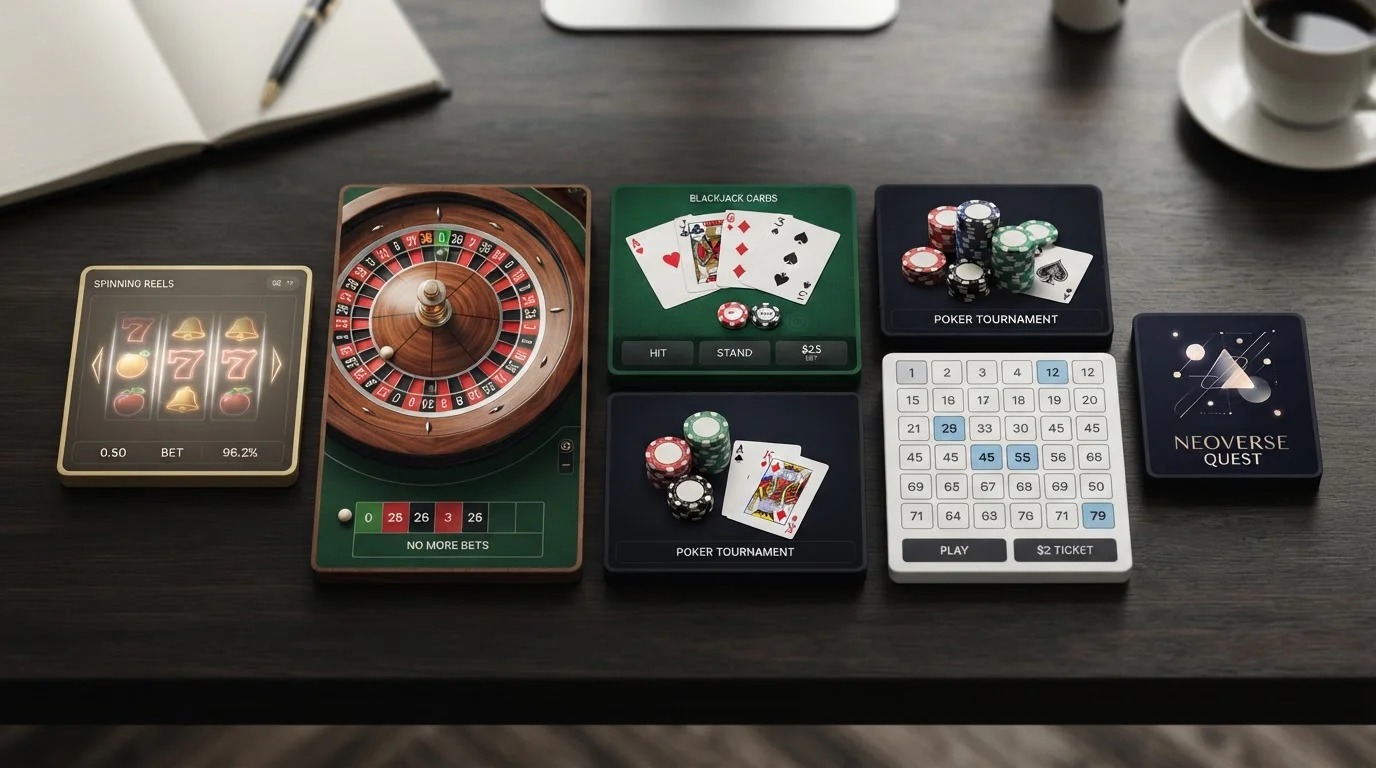
Table of Contents
Slots and Familiar Table Formats
JustBet groups familiar casino formats alongside titles with a more experimental structure. The product lists slots, originals, blackjack, roulette and player-versus-player poker. Additional categories in the independent casino profile include video poker, baccarat, keno and other card games. These are useful distinctions because each format exposes players to different rules, settlement cycles and ways of presenting chance. A familiar name is only a starting point: a slot and a roulette game can both accept repeated wagers while producing very different event sequences.
A slot typically resolves a wager by evaluating symbols against a paytable. The relevant features are its reel structure, eligible combinations, bonus events within the game and the way a stake maps to a payout. A screen that looks simple can contain several separate betting variables. Changing the bet size or number of lines can change total exposure without changing the length of a session. It is therefore useful to separate the visible credit balance from the cumulative amount staked across repeated rounds.
Blackjack, roulette and baccarat use recognisable table-gameulary. Their resemblance to traditional casino tables does not make every software implementation identical. Blackjack decisions depend on the displayed rules for the dealer, split hands, doubling and special outcomes. Roulette depends on its wheel design and specific bet types; a result for one spin has no memory of earlier spins. Baccarat involves defined hand outcomes and different bet selections. In all these formats, a published game rule matters more than the visual theme.
Video poker and keno illustrate two further patterns. Video poker combines a draw and a paytable whose particular payouts shape the mathematical result; a player should not substitute assumptions from one paytable for another. Keno revolves around selections from a number field and a structured prize schedule. Neither is interchangeable with PvP poker, where other participants and the rules for the pot can matter. The originals section examines the different design questions raised by creator-published games.
- Slots: repeated independent game rounds with game-specific paytables and possible extra features.
- Table formats: named rule sets that may differ across individual titles.
- Video poker and keno: outcomes shaped by a stated paytable or draw-and-match structure.
- Creator-made originals: formats that should be examined by their individual mechanics.
Blackjack, Roulette and Poker
JustBet presents blackjack, roulette and PvP poker within its casino catalogue. They share a broad association with cards or tables but operate on different decision models. In blackjack the central question is what a player’s hand can do under a particular rule set. In roulette the central question is which outcome space and payout schedule a chosen bet covers. PvP poker, by contrast, involves interaction between players and a contest for a pot rather than a simple house-versus-player draw.
In blackjack, two games can look almost identical while differing in whether the dealer draws on a soft hand, how doubling works, or what happens after splitting. Such details affect the possible decisions and theoretical game cost. A strategy developed for one rule set should not be imported blindly into another. A visible rules panel is part of understanding the game, not a guarantee of any individual outcome. The presence of an action button says little about whether a decision is advantageous without the exact hand and rule context.
Roulette presents a different cognitive trap. After several outcomes of the same colour, it may feel as though a different colour is due. Independent spins do not work that way. A previous result is history, not evidence of a changed future probability. Different roulette layouts also differ in their numbers of possible pockets, which can affect their mathematical properties. The exact wheel and bet schedule are what matter, rather than the generic category name displayed in a menu.
For PvP poker, the distinction is not merely cosmetic. Player interaction, wagering rounds, hand ranking and the method for distributing the pot all become central. A casino catalogue entry labelled poker is not enough to infer the table limits, game variants or rules for participation. Readers comparing it with conventional blackjack should pay attention to the source of the outcome: other players’ decisions are part of a poker hand, while blackjack relies on a defined dealer procedure.
| Format | How a round is resolved | Useful rule to understand |
|---|---|---|
| Slots | Symbol combinations and paytable | Stake, features and line mechanics |
| Blackjack | Card totals and dealer rules | Splits, doubles and dealer actions |
| Roulette | Numbered wheel outcome | Wheel layout and bet coverage |
| PvP poker | Competing hands and decisions | Pot, ranking and betting rounds |
| Keno | Draw compared with selections | Match counts and payout schedule |
This comparison is about the mechanics of categories listed for JustBet; it does not assign a return rate or house edge to any individual title. A numerical comparison would require the exact rules and paytable for that title. The game’s label alone cannot supply that calculation.
Originals and Creator-Made Titles
A distinctive part of JustBet is its creator-casino model. The platform describes creators building and publishing games, so a catalogue can contain titles with mechanics that extend beyond established table-game templates. The platform also refers to an on-chain bankroll financed by independent liquidity providers. Those roles are separate: the creator defines a game experience, the underlying infrastructure handles parts of the game system, and liquidity provision concerns the capital exposed to outcomes.
That distinction has practical consequences. A polished creator game may borrow familiar motifs while applying a different outcome sequence. A player should look for the exact stake denomination, the available outcomes, the rules that trigger a resolution and the final payout calculation. The fact that two titles share an infrastructure layer does not make their wagering rules identical. Nor does a creator’s ability to publish establish a particular quality standard for each published title.
WINR is identified as a provider associated with JustBet’s catalogue. Its appearance connects the site to a specialised games ecosystem, but it should not be confused with a promise about every game or every transfer. WINR also appears in JustBet’s broader crypto-payment context. A shared token name can connect different parts of a product without making all operations — staking, settlement, wallet movement and game rules — one and the same thing.
For a fuller explanation of the relationship between publishing and liquidity, see JustBet Originals and creator-made games. The broader payments discussion treats blockchain wallet movements separately from the game outcome itself. This distinction is especially useful when reading an interface that displays token balances and game results together.
- Identify the title’s developer or creator and its specific rule presentation.
- Read how the wager is defined before interpreting any payout display.
- Distinguish the generation of an outcome from the later transfer of value.
- Evaluate the session as a sequence of stakes, rather than judging by one result.
Seed, Nonce and Game Fairness Basics
JustBet describes a provably fair procedure built around a server seed hash, a client seed and a nonce, with HMAC-SHA256 used in outcome verification after server-seed rotation. These terms describe a reproducibility mechanism. They do not describe the expected return of a game, the security of a user’s wallet or the treatment of every possible account dispute.
In the standard commitment idea, a secret server seed is committed by revealing a hash before the seed itself is disclosed. The player has a client-side value, and a nonce identifies a particular event or round. The game can use the seed values and the nonce to compute an outcome deterministically. Once the server seed is revealed, the relevant inputs can be checked against the earlier commitment and then used to repeat the computation. A matching result answers a narrow question: did the published inputs reproduce the displayed outcome?
The order matters. If the server could silently swap a committed seed after observing results, the purpose of the commitment would be weakened. A hash is intended to make such a change detectable after disclosure, subject to the particular implementation. The nonce matters because it distinguishes one calculation from the next. A client seed matters because it introduces another input into the computation rather than leaving all input selection hidden in a single server value.
HMAC-SHA256 combines a cryptographic hash function with a keyed computation. Seeing that term on a platform is not enough to independently recreate a game result. Verification also requires the precise input formatting, encoding, order of operations, result mapping and relevant revealed seed. For example, a correct digest can still be transformed into a game result incorrectly if the mapping is not followed as specified. The important question is whether the entire transformation can be repeated from the disclosed inputs, not whether the algorithm has a familiar name.
Reproducibility is also different from favourable odds. A mathematically reproducible loss remains a loss. Even a fair random process can produce extended streaks and uneven short-session results. A commitment scheme is not a promise that results will alternate, that a balance will recover or that a house edge is absent. It addresses the integrity of one narrow computational process. An explanation of creator-specific implementations appears in the originals guide.
What does a nonce do?
It acts as a round-specific input, helping distinguish repeated calculations that use related seed material. Its meaning depends on the game’s implementation; it is not a measure of how likely a win has become.
What does a revealed server seed allow?
A disclosed seed can be checked against an earlier hash commitment and used with the other specified inputs to reproduce an outcome calculation.
Session Costs and Game-Rule Discipline
A game session can appear uneventful while generating a large amount of cumulative wagering. For example, multiplying a chosen stake by the number of resolved rounds gives total amount wagered, which is different from the opening balance and different again from the final account balance. This is an arithmetic illustration, not a return estimate for JustBet. Repeated wagers create exposure even when some individual results return money to the balance.
RTP and house edge are long-run mathematical properties of specific games under specific assumptions. They do not determine the outcome of a short run and cannot be transferred from a generic game category to one unnamed title. A hypothetical expected-loss calculation multiplies cumulative wagering by an assumed house edge. It describes an average across many comparable repetitions, while actual sessions can deviate substantially. Without the exact game rule and return figure, a numerical claim about a JustBet title would be misleading.
Fast-resolving games deserve special attention because the number of rounds can climb more quickly than a player notices. The practical distinction is between elapsed time and amount put at risk. A brief session with many outcomes can involve more cumulative stakes than a slower session that uses the same initial balance. A clear stopping boundary should be defined in terms of money and time, rather than an expectation that the next round will offset earlier losses.
Crypto-denominated balances add an additional dimension: the token’s value can change separately from a game outcome. A stable token balance does not necessarily mean a stable value measured in Australian dollars. Blockchain transfer costs and irreversibility are explained in the JustBet payments article. The crucial distinction is that a game result, token balance and external market value are three different measurements.
Gambling can cause financial harm. Help is available from Gambling Help Online at gamblinghelponline.org.au and 1800 858 858. This information is intended for adults aged 18 and over, not as a suggestion to access or participate in an online casino.
Questions About JustBet Games
What types of games does JustBet list?
JustBet lists slots, blackjack, roulette, PvP poker and originals. An independent casino profile also includes video poker, baccarat, keno and other card games.
What makes JustBet originals different?
The creator-publishing model lets game makers produce titles beyond the familiar slot and table categories. Each title needs to be understood through its own rules.
How does seed-based outcome verification work?
JustBet describes a server-seed commitment, client seed and nonce, with HMAC-SHA256 used to reproduce calculations after seed rotation.
Does a provably fair result guarantee a win?
No. Reproducible random outcomes can include losses and streaks. Verification does not determine a favourable expected return.
Are blackjack and PvP poker the same format?
No. Blackjack applies dealer and hand rules, whereas PvP poker is built around competing player decisions and hand outcomes.
Which Game Mechanics Deserve Attention
The defining feature of the JustBet catalogue is the combination of recognisable casino games with creator-published formats. Meaningful evaluation depends on the individual title: its rules, stake structure and outcome method. Seed-based checks can address reproducibility, while session-cost discipline and independent judgment remain necessary for financial risk.